Category Archives: Explainer

What Is Distributed Computing?

Quanta Magazine

Our computers can get a lot more done when they share the load with other machines.

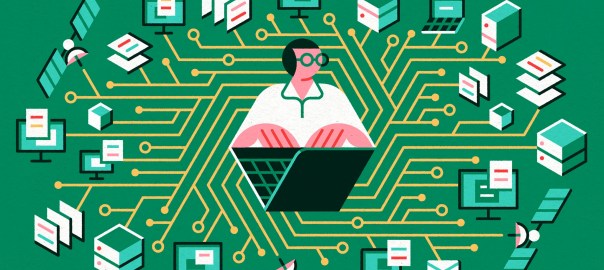
No device is an island: Your daily computational needs depend on more than just the microprocessors inside your computer or phone. Our modern world relies on “distributed computing,” which shares the computational load among multiple different machines. The technique passes data back and forth in an elaborate choreography of digital bits — a dance that has shaped the internet’s past, present and likely future.

Read the full story in Quanta Magazine

Is climate resilience possible in a world of borders?

SEQUENCER

We govern deforestation, agriculture, and biodiversity within our own borders. But unchecked sovereignty may be a mistake.

In January 2008, global rice prices shot to record highs. Shipping costs, a multi-year Australian drought, and erratic weather in Asia choked yields. In producer countries, the fear of dwindling stockpiles prompted the governments of India, Vietnam, Brazil, Egypt, and elsewhere to halt exports, safeguarding their own supplies but propelling prices up to four times higher than normal.

This meant trouble for countries reliant on foreign rice. Senegal, for example, has depended on grain imports since the 1800s when its French colonizers steered Senegal’s agriculture toward cash crops like peanuts, and instead imported rice from France’s Asian colonies. In 2008, the impact of these past decisions was civil instability: people protested against political leaders as many could not afford rice.

For most outside observers, this was bad enough, yet when the scarcity ended we quickly forgot about the crisis. But to Ariadna Anisimov, a postdoctoral researcher at the Institute of Development Policy at the University of Antwerp, this example is a quintessential case of “transboundary climate risk” that the world is ill equipped to handle in the future. For her, the link between climate change and societal instability couldn’t be clearer.

What makes the cautionary rice tale prototypical is its demonstration of not just the tangled web of climate and livelihoods around the world, but also the global consequences of domestic policies. Export bans shielded the producer at the expense of the market. For an importing country like Senegal to become self-sufficient in rice, they’d need major agricultural changes. But climate change was already affecting farmer’s yields through more variable rain and more salt in groundwater; and irrigating with river water remained both a touchy subject with neighboring countries and flooding risk.

“Rivers have been shifted, and turned, and irrigated to make barrages and hydropower,” Anisimov told me. “There’s always competing interests between the upstream and the downstream communities, and they have a lot of cascading effects, especially because rivers cross borders.”

Climate change’s drivers and hazards don’t obey borders, yet the laws and regulations meant to control them are confined within national boundaries. So how do we reckon with the fact that necessary climate action may be incompatible with how our entire world is organized?

Read the full story and support our work in Sequencer Magazine
How Did We Draw The Planet Before We Actually Saw It?

SEQUENCER

The story of our not-so-Blue Marble

NOTE: This is the first story of mine for Sequencer, a writer-owned science magazine and newsletter that I’ve launched with three fellow science journalists that I admire. It would mean the world to me if you’d take a moment to subscribe here: https://www.sequencermag.com/

I spend a large portion of my work day feeling confused. I start my days bewildered by advances in niches of science that I only recently learned existed. Chatting with experts usually resolves my initial confusion, but immediately after spawns more: Every question begets an answer and more questions, ad infinitum.

To me, there’s no more jolting brand of bewilderment than doing a double take on the everyday things. New discoveries may lurk in the mundane. The ubiquitous, almost cartoonish image we have in our heads of the Earth might seem like a trivial matter now, but seriously, how did we get there?

So let’s first lay out what I mean by Earth’s appearance. How did we know how to draw Earth until we sent cameras and people into space to snap some pictures? Sure, we know that land is greenish, oceans are blueish, and that mapmakers have spent millenia tracing the contours of continents, but these details tell us about Earth’s appearance in theory more than in reality. Think of it this way: I know the color of my hair and skin, as well as the shape of my head and mouth, yet I still study the bathroom mirror in the morning to see who or what I’m working with that day. What about the appearance of that Earth—the “woke up like this” Earth?

Turns out this wasn’t a trivial problem; and in some ways, we kinda didn’t know what Earth actually looked like until we saw it from space.

Read the full story on Sequencer

How Your Body Adapts to Extreme Cold

WIRED

Scientists are finding a dynamic story in human physiology linked to frigid temperatures—a story that climate change may rewrite.

A bitter winter storm is sweeping across the north-east of North America this weekend, and is expected to bring significant snow to New York City for the first time in two years. Low temperatures around freezing are expected to last into next week.

If this is making you miserable, it’s because you, like most people, overwhelmingly prefer hot places. That group does not include Cara Ocobock, a biological anthropologist at University of Notre Dame who is one of the scientists trying to understand how the human body adjusts to extreme cold. “I just handle cold much better than I can handle heat,” says Ocobock.

Researchers like Ocobock have recently uncovered a variety of physiological adaptations linked to cold. Those range from anatomical to metabolic changes, and can stem from generations of natural selection or simply the short-term effects of acclimatization. These discoveries help people make practical decisions today, and most important to Ocobock, they hint at what we should expect in an increasingly capricious climate where winter cyclones freeze people in what are normally hot places, and heat waves make people swelter in what are normally icy ones.

Read the full story in WIRED

The Hidden Connection That Changed Number Theory

Quanta Magazine

Quadratic reciprocity lurks around many corners in mathematics. By proving it, number theorists reimagined their whole field.

There are three kinds of prime numbers. The first is a solitary outlier: 2, the only even prime. After that, half the primes leave a remainder of 1 when divided by 4. The other half leave a remainder of 3. (5 and 13 fall in the first camp, 7 and 11 in the second.) There is no obvious reason that remainder-1 primes and remainder-3 primes should behave in fundamentally different ways. But they do.

Read the full story in Quanta

From Pond Scum to Product: The Chemistry of Algae

CHEMMATTERS

The first time Beth Zotter tried her company’s bacon, it tasted bitter, and powdery. “Most protein concentrates don’t taste very well,” says Zotter, cofounder and chief executive officer of Umaro Foods. Umaro was attempting to re-create crispy, savory bacon out of seaweed.

Why bacon? “It’s America’s favorite food,” said co-founder Amanda Stiles on an episode of the TV show, “Shark Tank,” where the two raised funds for Umaro. “It’s the holy grail of plant-based meat. Sizzling, salty, delicious.” But the real magic of Umaro’s pitch was not the bacon. It was the algae.

Read the full story in ChemMatters April Issue

Surprise! The Pandemic Has Made People More Science Literate

WIRED

Despite rampant misinformation, Covid-19 has pushed science into the zeitgeist, as people have absorbed new words and how scientific discovery actually works.

FOR THREE GENERATIONS, Betsy Sneller’s family has sipped something they call “Cold Drink.” It’s a sweet mix of leftover liquids, stuff like orange juice and the remnants from cans of fruit, a concept devised by Sneller’s grandmother during the Great Depression. “All the little dregs get mixed together, and it tastes like a fruity concoction,” Sneller says. Cold Drink is an idea—and a name—born from crisis.

Sneller is now a sociolinguist at Michigan State University who studies how language changes in real time. For nearly two years, Sneller has analyzed weekly audio diaries from Michiganders to understand how the pandemic has influenced language in people of all ages, a project initially called MI COVID Diaries. “We find very commonly that people will come up with terms to reflect the social realities that they’re living through,” they say. “New words were coming up almost every week.” As Covid-19 sank its spikes into daily life, people added words and phrases to their vocabularies. Flatten the curve. Antibodies. Covidiots. “Shared crises, like the coronavirus pandemic, cause these astronomical leaps in language change,” Sneller says.

But Sneller has also noticed a more substantive trend emerging: People are internalizing, using, and remembering valuable scientific information. “Because the nature of this crisis is so science-oriented, we’re seeing that a broad swath of people are becoming a little bit more literate in infectious diseases,” they say.

Read the full story in WIRED.

The Artificial Leaf: Copying Nature to Fight Climate Change

ACS ChemMatters Magazine

An ancient chemical process enabled Earth to become a lush place teeming with life. Now researchers are replicating this process in an attempt to slow global warming.

Every plant, animal, and person owes their life to one sequence of chemical reactions: photosynthesis. The process, which converts water and carbon dioxide into food using sunlight, first evolved in cyanobacteria more than 2 billion years ago.

That’s right. Plants weren’t the first organisms to develop photosynthesis, though they are better known for it. Cyanobacteria are the ones that originally filled the atmosphere with photosynthesis’s gaseous by-product, oxygen (O2), which set the stage for more diverse life on Earth.

As beneficiaries of photosynthesis, humans depend on plants in a sort of carbon seesaw. Plants take in CO2 and release O2. They store that carbon as sugar. Hanging vines, grass, and trees all grow by pulling carbon atoms out of the air. We do the reverse, taking in O2 and releasing CO2. Finally, everything we eat completes the handoff: Human eats plant (or the animal who already did), human exhales, plant stores carbon, and the cycle continues.

This seesaw is part of the much broader carbon cycle that has affected the radiation balance of our planet. Cutting down huge swaths of forests and the burning of carbon-based fossil fuels causes the levels of CO2, a major greenhouse gas, to rise. And plants on Earth along with other natural parts of the carbon cycle can’t restore the balance on their own.

But what if we could copy what plants do to grab some of that excess CO2 to make fuels sustainably, instead of relying so heavily on fossilized carbon?

Read the full story in the October 2021 issue of ChemMatters

How to Make Fashion Sustainable

ACS CHEMMATTERS

Take a minute to think about what you’re wearing right now. Not the colors or cuts of fabric you grabbed out of your closet this morning—but the textiles your clothes are made of.

Before your clothes became clothes, they were raw resources that were collected, processed, woven into textiles, then cut and sewn into the garments on your back. And their life cycle doesn’t end there. Nearly 90% of clothing takes an inevitable trip from closet to landfill. The problem is that although this process provides short-term convenience for customers and the fashion industry, in the long run, it’s not sustainable. Making and transporting clothes consumes raw materials and, at every step in the process, emits greenhouse gases.

Read the full story in ACS ChemMatters (Printed in the April 2021 Issue)