Tag Archives: Nature

What we learn in the footsteps of wolves

Sequencer

Up close and personal with nature’s notoriously elusive carnivore.

In the summer of 1986, biologist L. David Mech crept over a hill on an island 500 miles from the North Pole and spotted a pack of white Arctic wolves. He’d spent days clambering over rocks and hiking across treeless ridges under 24-hour-daylight searching for a den. Few if any scientists had ever studied wolves at their dens. Mech had devoted nearly three decades to wolves, but rarely eavesdropped from the ground and never at a den. Now, 200 meters from his mattress, he counted one, two, three, four, five, six. Six five-week-old pups, along with seven adults, all unfazed by him and his ATV.

“It was the highlight of my life,” Mech later wrote in a National Geographic magazine. “After twenty-eight years, I had finally scored the Big One.” This marked the beginning of a renaissance in wolf biology that continues to this day; a renaissance that’s crept out of the Arctic and into wild and urban areas around the world.

Wolves are feared and revered from Norse and Roman mythology to Indigenous American tradition. In modern politics, they fracture public opinion over questions like What does it mean to conserve the wilderness? and at what cost to human lifestyles should we be protecting carnivores?

Wolves are elusive. Their internal and social lives are difficult to pin down. And our efforts to control them—even understand them—continuously turn up surprises.

Two recent books offer a rare lens into the lives of wolves. The Ellesmere Wolves, written by Mech and published in March, unfurls decades of observations of the world’s most tame wild wolf populations on the Canadian island of Ellesmere. Lone Wolf, from author Adam Weymouth, published in June, retraces the steps of Slavc, a wolf who famously journeyed across Europe alone in 2011 and 2012.

The contexts differ: Weymouth is a journalist following GPS data through beech forests, alpine prairies, and populated villages, discovering the grim political consequences of wolves’ success repopulating across Europe. Mech is a veteran field biologist documenting the world’s most remote Arctic wolves. Mech lived in close contact with wild wolves. He observed unprecedented behaviors around their dens like ambushing prey, and adults hugging chest-to-chest.

Yet, common themes emerge. Weymouth confronts the romantic ideal of a “lone wolf” who embarks on fiercely independent journeys. Mech, in his writings, confronts a wolf phenomenon that has transcended science into human culture—the alpha wolf.

“I think it’s really crucial to kind of tell these animal stories,” Weymouth told me. “But I do think those stories are really hard for people to connect to.”

Read the full story in Sequencer Magazine

The Hidden World of Electrostatic Ecology

QUANTA MAGAZINE

Invisibly to us, insects and other tiny creatures use static electricity to travel, avoid predators, collect pollen and more. New experiments explore how evolution may have influenced this phenomenon.

Imagine, for a moment, that you’re a honeybee. In many ways, your world is small. Your four delicate wings, each less than a centimeter long, transport your half-gram body through looming landscapes full of giant animals and plants. In other ways, your world is expansive, even grand. Your five eyes see colors and patterns that humans can’t, and your multisensory antennae detect odors from distant flowers.

For years, biologists have wondered whether bees have another grand sense that we lack. The static electricity they accumulate by flying — similar to the charge generated when you shuffle across carpet in thick socks — could be potent enough for them to sense and influence surrounding objects through the air.

Read the full story in Quanta Magazine

The biggest threat to biodiversity you’ve never heard of

Sequencer

As a fungus pushes dozens of amphibians into extinction, researchers search for whatever hope they can grab.

Erin Lundy hasn’t always loved frogs. The Hawaiʻi-born biologist and animal care expert had more of a soft spot for marine mammals and in 2018 began working with otters and seals at the Aquarium of the Pacific in Long Beach, California. “They’re very cute, charismatic, and smart,” Lundy told me. Frogs may be cute, she added, but they’re not known for their smarts. 

A couple years into her work in Long Beach, the aquarium needed help with amphibian conservation. A coworker asked if Lundy liked frogs. She replied: “Yeah, enough.”

Against all odds, she came around on amphibians. At first glance, a palm-sized tattoo of an otter inside Lundy’s forearm backs up her professed love of mammals. But there’s a surprise in the tattooed otter’s grasp: a tiny, colorful mountain yellow-legged frog. “It turns out I really like frogs,” she said. 

Lundy became captivated by how in tune frogs are with their habitat. Amphibians have porous, permeable skin that sensitizes them to all the chemicals and conditions of their environment. “They like stability — they don’t like super hot, super cold,” Lundy said. “They’re incredible indicator species of what the health of our environment actually looks like.” 

Read the full story in Sequencer Magazine

Don’t step on this caterpillar

SEQUENCER

A Brazilian research institute is the only thing standing between a caterpillar sting and an untimely, grisly death.

In the 1990s, an unlikely culprit sparked an outbreak in southern Brazil. People poured into clinics with severe bruises and mysterious, gangrene-like symptoms. Some patients even suffered brain bleeds and died. The cases initially baffled researchers, who investigated patients’ accounts by probing the surrounding lands and trails. Site after site, they found Lonomia obliqua larvae: two-inch caterpillars with cactus-like spines out of their greenish brown bodies. 

You don’t want to mess with Lonomia obliqua’s prickly prepubescent hairs. If you touch or step on its clumps of spines, venom trickles into your bloodstream, carrying with it procoagulants that spread clots across your body. The venom can deplete your blood’s ability to clot when you actually need it, heightening the risk for internal bleeding and hemorrhage. Lonomia caterpillars cause painful, bloody deaths.

Brazilian officials recorded 600 stings between 1989 and 1996, including 12 deaths, cementing L. obliqua’s place as the world’s deadliest caterpillar. The situation has only gotten more dire: between 2007 and 2017, researchers documented more than 42,000 stings and roughly 250 serious poisonings—only now, there’s an antidote.

Read the full story and support our work in Sequencer Magazine

Bears Are Coming to a Campground Near You

WIRED

Extreme heat and other weather events are driving bears closer to humans’ campgrounds and hiking trails—and that’s no good for either species.

STEPS AWAY FROM the public restrooms in Yosemite Village, a buzzy stop in Yosemite National Park’s iconic valley, sits a brown metal dumpster. Visitors reach up to open the trash chute. Their peanut butter jars and apple cores tumble into a sealed compartment. The slot slams shut. Then, they clip a tethered steel carabiner through a loop, which prevents less dextrous creatures from getting access. “USE CLIP,” reads a sticker on the chute. “SAVE A BEAR.”

Read the full story in WIRED

From Pond Scum to Product: The Chemistry of Algae

CHEMMATTERS

The first time Beth Zotter tried her company’s bacon, it tasted bitter, and powdery. “Most protein concentrates don’t taste very well,” says Zotter, cofounder and chief executive officer of Umaro Foods. Umaro was attempting to re-create crispy, savory bacon out of seaweed.

Why bacon? “It’s America’s favorite food,” said co-founder Amanda Stiles on an episode of the TV show, “Shark Tank,” where the two raised funds for Umaro. “It’s the holy grail of plant-based meat. Sizzling, salty, delicious.” But the real magic of Umaro’s pitch was not the bacon. It was the algae.

Read the full story in ChemMatters April Issue

Scientists Reexamine Why Zebra Stripes Mysteriously Repel Flies

WIRED

While biologists still aren’t exactly sure how it works, a new study closes in on why the insects that pester Savannah animals zig when anything zags.

ABOUT 30 MILES north of the equator, in central Kenya, Kaia Tombak and her colleagues stood beside a plexiglass box. Tombak, who studies the evolution of animals’ social behavior, was dressed for the power of the Savannah sun in a light, long-sleeved shirt and pants. A gang of flies buzzed nearby, and Tombak wondered whether she’d be better off wearing stripes.

Read the full story in WIRED

Sorry, Prey. Black Widows Have Surprisingly Good Memory

WIRED

Despite having tiny arthropod brains, spiders in a new experiment showed some complex cognitive calculations.

BLACK WIDOWS MUST despise Clint Sergi. While working on his PhD in biology at the University of Wisconsin-Milwaukee, Sergi spent his time designing little challenges for spiders—which often involved rewarding them with tasty dead crickets, or confounding them by stealing the crickets away. “The big question that motivated the work was just wanting to know what is going on inside the minds of animals,” he says.

Biologists already know spider brains aren’t like human brains. Their sensory world is geared for life in webs and dark corners. “Humans are very visual animals,” says Sergi. “These web-building spiders have almost no vision. They have eyes, but they’re mostly good for sensing light and motion.” Instead, he says, a black widow’s perception comes mainly from vibrations, kind of like hearing. “Their legs are sort of like ears that pick up the vibrations through the web.”

Read the full story in WIRED

The Brutal Reason Some Primates are Born a Weird Color

WIRED

When species have babies with conspicuous fur, it can attract good attention—or bad. A new theory could explain why.

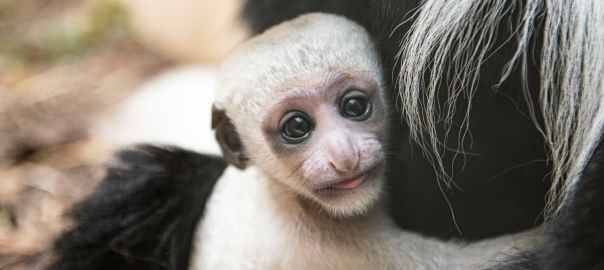
THE FIRST THING you might notice about the Delacour’s langur is its color. It’s got a jet black torso, limbs, and head, with a shaggy white butt sandwiched in the middle. (These monkeys—Trachypithecus delacouri if you want to get technical—quite literally look like Oreos.) But that’s just how the adults look. The babies are a different story: They’re orange.

This is their distinct “natal coat,” which fades after a few months. Babies from dozens of other primate species also have fur that’s a different color from that of adults. “One of the big questions has always been why—why would they have distinct coats?” asks Ted Stankowich, an evolutionary ecologist and Director of the Mammal Lab at California State University Long Beach.

Read the full story in WIRED