The Modern World Is Aging Your Brain

WIRED

In a remote part of the Amazon, anthropologists and neuroscientists are learning about life and health without an “embarrassment of riches.”

BESIDE THE SCHOOLHOUSE turned medical station in the northern Bolivian village of Las Maras, everyone is waiting for breakfast. Today’s meal is rice and eggs, generously salted and adorned with globs of mayo: hearty fuel for a workday of foraging and hunting animals. Sheltering from the rain under palms, rubber trees, and a series of large tarps, the people are aged from 40 to 80-plus—all of them Tsimane, an Indigenous group living in the lowlands of the Amazon.

Each has been asked to fast until after they’ve had a voluntary medical exam. Blood draws. Urine and stool samples. Respiratory tests under one tarp; artery stiffness measurements under another. While they wait to speak with a doctor, people give interviews to fellow Tsimane who are collecting anthropological data. Later—if they desire—the interviewees will take a drive to the nearby city of Trinidad to get their brains scanned.

Read the full story in WIRED

Fighting Climate Change One Meal at a Time

CHEMMATTERS

Beth Zotter can talk about anything. The problems she encounters as chief executive officer (CEO) of a food company named Umaro are very specific. But the main focus is algae—which Zotter’s Umaro Foods claims is the future of abundant, sustainable protein—and its mission is to save our planet from climate calamity.

Read the full story in ChemMatters April Issue

From Pond Scum to Product: The Chemistry of Algae

CHEMMATTERS

The first time Beth Zotter tried her company’s bacon, it tasted bitter, and powdery. “Most protein concentrates don’t taste very well,” says Zotter, cofounder and chief executive officer of Umaro Foods. Umaro was attempting to re-create crispy, savory bacon out of seaweed.

Why bacon? “It’s America’s favorite food,” said co-founder Amanda Stiles on an episode of the TV show, “Shark Tank,” where the two raised funds for Umaro. “It’s the holy grail of plant-based meat. Sizzling, salty, delicious.” But the real magic of Umaro’s pitch was not the bacon. It was the algae.

Read the full story in ChemMatters April Issue

This is the Lightest Paint in the World

WIRED

An energy-saving coating needs no pigments, and it keeps the surface beneath it 30 degrees cooler.

DEBASHIS CHANDA HAD trouble finding a physicist who could paint. The researchers in his nanoscience lab at the University of Central Florida had already worked out the kinks in the high-end machinery needed to create a revolutionary new kind of cooling paint. They had filled vials with vivid colors. But when it came time to show it off, they hit a wall. “We could barely draw a butterfly by hand, which is kind of a kid’s drawing,” says Chanda.

They did it anyway. The shape and the four-color design do look basic, but the simplicity is deceptive. If you zoom in deep—to invisible dimensions—this paint is almost nothing at all like the paint you know.

Read the full story in WIRED

Can We Destroy ‘Forever Chemicals’?

INVERSE

Emerging tech could wipe out tiny toxic substances from drinking water.

To ensure that drinking water is safe for consumption, the U.S. Environmental Protection Agency is proposing the first-ever federal restrictions on six “forever chemicals” known to harm human health. The agency will hold a public comment session on May 4 and expects to finalize the regulation by the end of this year.

Previously, the EPA recommended limiting the levels of two varieties of PFAS — perfluorooctanoic acid (PFOA) and perfluorooctanesulfonic acid (PFOS) — to 70 parts per trillion in drinking water. Now, the agency wants to mandate stricter levels: 4 ppt for PFOA and 4 ppt for PFOS. Four other kinds of PFAS will also be regulated on a proposed “hazard index” to determine their cumulative risk.

“EPA anticipates that if fully implemented, the rule will prevent thousands of deaths and reduce tens of thousands of serious PFAS-attributable illnesses,” the agency wrote in a statement.

Scientists and environmental groups are praising the proposal, which they say is long overdue. But setting limits is just half the battle: Scientists are now hunting for ways to filter and destroy the chemicals before they can make it into our water.

Read the full story in Inverse

This Lab-Grown Skin Could Revolutionize Transplants

WIRED

A new kind of “edgeless” engineered tissue can fit any irregular shape, paving the way for hand and face grafts that look and move better.

ALBERTO PAPPALARDO WAS nervous the morning before the transplant. He’d spent the previous month nurturing a cluster of skin cells until they reached their final form: a pinkish-white tissue in the shape of a mouse’s hindlimb that could be slipped onto the animal like a pant leg. If all went according to plan, the mouse’s surrounding skin would accept the lab-grown stuff as its own.

In the end, it took less than 30 seconds to position the new skin, and under 10 minutes to complete the whole procedure. “It was a perfect fit,” recalls Pappalardo, a medical doctor and postdoc focusing on dermatology and tissue engineering at Columbia University Medical Center. That’s a big deal, because it could help solve a persistent challenge in treating burns and other large wounds: how to cover irregular shapes with real, functional skin.

Read the full story in WIRED

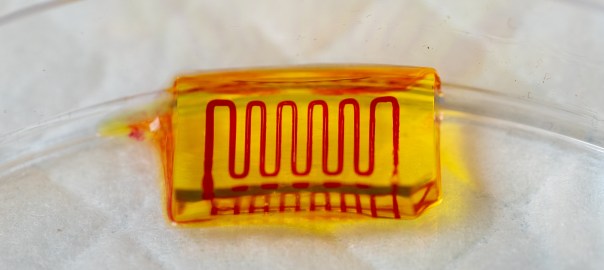
This Fake Skin Fools Mosquitoes With Real Blood

WIRED

Research on new repellents and the viruses these insects carry relies on lab animals and human volunteers. What if there was a better option?

THE WORLD’S DEADLIEST animal is a picky eater. Because they transmit viral diseases like Zika and chikungunya, and the parasites that cause malaria, mosquitoes like blood-sucking Aedes aegypti are responsible for over 700,000 deaths worldwide every year.

But in Omid Veiseh’s lab at Rice University, his team of bioengineers was struggling to get mosquitoes to eat. Typically, researchers study mosquitoe feeding by letting them bite live animals—lab mice, or grad students and postdocs who offer up their arms for science. That’s not ideal, because lab animals can be expensive and impractical to work with, and their use can raise ethical issues. Student arms don’t scale well for large tests.

In collaboration with entomologists from Tulane University, the Rice team wanted to develop a way of studying mosquito behavior without the challenges of experimenting on large numbers of animals. Their solution was something totally different: real blood encased in a lifeless hydrogel. “It feels like jello,” Veiseh says. “The mosquitoes have to bite through the jello to get to the blood.” 

Read the full story in WIRED

Machines Learn Better if We Teach Them the Basics

QUANTA MAGAZINE

A wave of research improves reinforcement learning algorithms by pre-training them as if they were human.

Imagine that your neighbor calls to ask a favor: Could you please feed their pet rabbit some carrot slices? Easy enough, you’d think. You can imagine their kitchen, even if you’ve never been there — carrots in a fridge, a drawer holding various knives. It’s abstract knowledge: You don’t know what your neighbor’s carrots and knives look like exactly, but you won’t take a spoon to a cucumber.

Artificial intelligence programs can’t compete. What seems to you like an easy task is a huge undertaking for current algorithms.

Read the full story in Quanta Magazine

The Case of the Incredibly Long-Lived Mouse Cells

WIRED

In a bizarre experiment, scientists kept the rodents’ immune T cells active four times longer than mice can live—with huge implications for cancer, vaccination, and aging research.

DAVID MASOPUST HAS long imagined how to push immune systems to their limits—how to rally the most powerful army of protective cells. But one of the big mysteries of immunology is that so far, nobody knows what those limits are. So he hatched a project: to keep mouse immune cells battle-ready as long as possible. “The idea was, let’s keep doing this until the wheels fall off the bus,” says Masopust, a professor of immunology at the University of Minnesota.

But the wheels never fell off. He was able to keep those mouse cells alive longer than anyone thought possible—indeed, much longer than the mice themselves.

Read the full story in WIRED