Tag Archives: Wired

You’re Not Alone: Monkeys Choke Under Pressure Too

WIRED

Now you can blame the primate brain. And neuroscientists are eager for a deeper look.

SITTING ALONE IN a dim room in Pittsburgh, Pennsylvania, Earl flung his arm to the left. He slowed his movement down, examining the position of a cursor on the computer screen in front of him. Where his hand went, so did the cursor. Earl gestured the dot closer to a colorful target zone, just as he had done thousands of times before. This time, he expected a big reward, but instead—time’s up. Earl, a rhesus monkey, choked under the pressure. He didn’t move the dot into the target before the timer ran out.
Read the full story in WIRED.

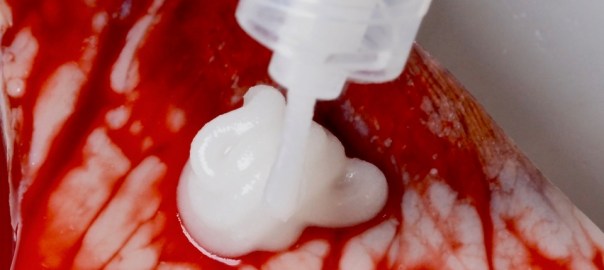
This Barnacle-Inspired Glue Seals Bleeding Organs in Seconds

WIRED

The paste sticks onto wet tissue firmly by repelling blood. Surgeons hope it can save time—and lives.

EXCESSIVE BLEEDING IS, in some sense, an engineering problem.

“For us, everything is a machine, even a human body,” says Hyunwoo Yuk, a research scientist in mechanical engineering at MIT. “They are malfunctioning and breaking, and we have some mechanical way to solve it.”

About 1.9 million people die every year from blood loss, sometimes from trauma, sometimes on the operating table. Bleeding bodies are wet, prone to infection, and need urgent care. Yet it’s hard to create a seal on wet tissue, and most commercial products used to stop dangerous bleeding rely on coagulants which take minutes to work. Some people don’t have minutes.

Read the full story in WIRED

The Squishy, Far-Out New Experiments Headed to the ISS

WIRED

Muscle cells, 3D-printed lunar regolith, and le Blob will soon orbit 250 miles above Earth.

ON TUESDAY, NORTHROP Grumman’s Cygnus cargo spacecraft will haul slime mold, human muscle cells, 3D printer parts for simulated moon rocks, and a mishmash of other exploratory scientific projects to the International Space Station.

The ISS has a long history of hosting experiments designed by scientists eager to explore how rocket launch, microgravity, and handling by astronauts might affect well-established (but Earthly) phenomena. The technologies behind experiments aboard this week’s rocket range from advancing human space exploration to solving health problems on Earth.

A 3D “regolith” printer may end up on a future moon build, and muscle cells grown aboard the ISS may help find drugs to treat age-related muscle loss on Earth. The mesmerizingly complex growth of the slime mold, on the other hand, is largely meant to be educational; it’s aimed at entrancing the hundreds of thousands of students who will be following its progress.

Read the full story in WIRED.

What Rat Empathy May Reveal About Human Compassion

WIRED

Rats may feel concern when cage mates are trapped. But, like people, they don’t always care enough to help.

AGONY IS CONTAGIOUS. If you drop a thick textbook on your toes, circuits in your brain’s pain center come alive. If you pick it up and accidentally drop it on my toes, hurting me, an overlapping neural neighborhood will light up in your brain again.

“There’s a physiological mechanism for emotional contagion of negative responses like stress and pain and fear,” says Inbal Ben-Ami Bartal, a neuroscientist at Tel-Aviv University in Israel. That’s empathy. Researchers debate to this day whether empathy is a uniquely human ability. But more scientists are finding evidence suggesting it exists widely, particularly in social mammals like rats. For the past decade, Bartal has studied whether—and why—lab rodents might act on that commiseration to help pals in need.

Read the full story in WIRED

This Device Could Tune Your Heart—Then Dissolve Away

WIRED

The latest in “electronic medicine” offers an alternative to temporary pacemakers and could help reduce tissue scarring.

THE HEART—THAT PARAGON of natural rhythm—sometimes needs help to stay on beat. Permanent pacemakers, which supply jolts of muscle-contracting current to regulate each thump, can correct chronically irregular hearts, and temporary ones can resolve fleeting dysfunctions that follow open heart surgery. Doctors wire up the heart with electrical leads that pass through the skin, and the muscle tissue envelopes the intruding electrodes like quicksand.

But if the pacemaker is just a temporary precaution, it’s all got to come out. And that’s where it gets tricky.

Read the full story in WIRED

The Experimental African Houses That Outsmart Malaria

WIRED

A field test of custom-designed homes proves that when carbon dioxide can flow out, mosquitoes stay out too.

WHEN STEVE LINDSAY first traveled to Gambia in 1985, he met a man living in Tally Ya village whom he remembers as “the professor.” The professor knew how to keep the mosquitoes away.

That’s a big deal for people who live in this small West African country, which serves as the namesake for one of the most deadly bugs on the planet: Anopheles gambiae. “It’s probably the best vector of malaria in the world,” says Lindsay, a public health entomologist at Durham University in the United Kingdom. Malaria kills 384,000 people a year in Africa, 93 percent of whom are under 5 years old. The mosquito exploits human behavior by feeding at night when people are sleeping, transmitting the Plasmodium parasite that causes flu-like symptoms, organ failure, and death. “It’s adapted for getting inside houses and biting people,” says Lindsay.

Read the full story in WIRED

The Race to Put Silk in Nearly Everything

WIRED

The fiber has been considered a “miracle material” for anything from body parts to food. Has the revolution finally arrived?

ALI ALWATTARI STILL remembers the day he met the goats. It was mid-May, 19 years ago, in Quebec. The sun was lighting up the old maple sugar farm—and small huts where the goats were living. Alwattari, a materials scientist, had spent his career tinkering with chemistry equipment for Procter & Gamble, developing fibers used in Pampers and Swiffers. But the startup Nexia Biotechnologies was aiming to use an entirely different kind of polymer producer—and it was gazing back at him with its rectangular pupils.

Read the full story in WIRED

The Coelacanth May Live for a Century. That’s Not Great News

WIRED

Scale markings reveal that this weird fish’s lifespan is double what scientists first estimated. That also means they’re closer to extinction than we thought.

AFRICAN COELACANTHS ARE very old. Fossil evidence dates their genesis to around 400 million years ago, and scientists thought they were extinct until 1938, when museum curator Marjorie Courtenay-Latimer noticed a live one in a fisher’s net.

Found off the southeastern coast of Africa, coelacanths also live a long time—scientists have suspected about 50 years. But proving that lifespan has been tough. (Coelacanths are endangered and accustomed to deep waters, so scientists can’t just stick their babies in a tank and start a timer.) Now a French research team examining their scales with polarized light has determined that they can likely live much, much longer. “We were taken aback,” says Bruno Ernande, a marine ecologist who led the study. The new estimated lifespan, he says, “was almost a century.”

Read the full story in WIRED

Watch a Drone Swarm Fly Through a Fake Forest Without Crashing

WIRED

Each copter doesn’t just track where the others are. It constantly predicts where they’ll go.

ENRICA SORIA NEEDED soft trees. The mathematical engineer and robotics PhD student from the Swiss Federal Institute of Technology Lausanne, or EPFL, had already built a computer model to simulate the trajectories of five autonomous quadcopters flying through a dense forest without hitting anything. But an errant copter wouldn’t survive a tête-à-tête with a physical tree.

So Soria built a fake forest the size of a bedroom. Motion-capture cameras lined a rail hanging above the space to track the movement of the quadcopters. And for “trees,” Soria settled on a grid of eight green collapsible kids’ play tunnels from Ikea, made of a soft fabric. “Even if the drones crash into them,” Soria recalls thinking, “they won’t break.”

Read the full story in WIRED

The Sneaky, Lying Flower That Pretends to Be a Rotting Beetle

WIRED

Aristolochia microstoma finds love by smelling like death. Coffin flies can’t resist.

IT WAS THE butterflies that tipped them off. Thomas Rupp, a PhD student in ecology at the Paris-Lodron University of Salzburg, was walking through a mountain forest with his teammates near Athens, Greece, when he saw them: the insects that, when in caterpillar form, feed on a special kind of plant called Aristolochia microstoma. “Wherever I saw this butterfly flying,” Rupp says, “I knew that there must be some Aristolochia plants around.”

Rupp crouched down to find the plant’s unusual flowers lying hidden among rocks and leaves. They are a dark merlot red, and they look like an inflated bulb connected to a narrow tube tipped by a small pore called a stoma. The whole thing looks a lot like the entry to an intestinal tract. It’s not. It’s even weirder.

Read the full story in WIRED