SEQUENCER
A Q&A with science content creator Charlie Engelman about inspiring his audience of millions.


SEQUENCER
A Q&A with science content creator Charlie Engelman about inspiring his audience of millions.

Quanta Magazine
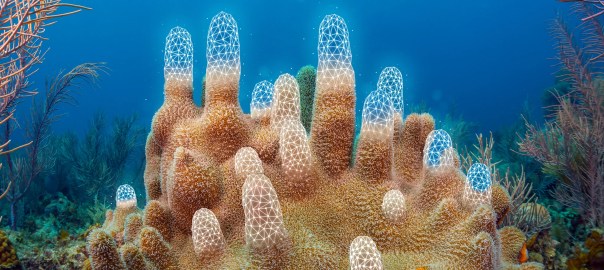
Physicists and marine biologists built a quantitative framework that predicts how coral polyps collectively construct a variety of coral shapes.
Since before she could remember, Eva Llabrés was a snorkeler. Her grandfather, a fishmonger from the Spanish island of Menorca, bought Llabrés her first mask and fins; throughout childhood, she was in the Mediterranean, spotting octopuses, eels, seagrasses and bright starfish. The ocean was a home, but in school, Llabrés preferred physics and math. In Barcelona for college, she dove into the theoretical mysteries of black holes and quantum gravity. After earning her doctorate, she changed gears: She wanted to come back to Earth, and she landed in the ocean. There, she found a world of unanswered questions in the physics of coral.

Sequencer | The Sick Times
As the factors that drive outbreaks snowball and Trump dismantles public health institutions, preparedness can come from the ground up.
Read the full story in Sequencer and The Sick Times
Sequencer
Scientific misinformation is a community problem. We can fight back by embracing uncertainty.
Twenty-five floors above the clouds of indoor cigarette smoke at the Horseshoe Casino in Las Vegas, Nevada, hundreds of self-described “skeptics” gathered to discuss science, health, and paranormal claims. But far from conspiracy thinking, this group organized by the Committee for Skeptical Inquiry defines skepticism as questioning facts in good faith. They arrived to learn how to recognize and combat misinformation. And ten days before the 2024 presidential election, I traveled to their Las Vegas conference as a science reporter with a similar goal.
Read the full story at Sequencer

WIRED
Cartilage cells that contain fat explain why some skeletal tissues are less rigid than others, and could one day be grown in labs to produce better materials for performing reconstructive surgeries.

Sequencer
What happens when you turn cacao into a microbiology experiment? Some damn good chocolate.
To say you “like chocolate” means almost nothing. There are people for whom chocolate means the rich soup of microwaved Ben & Jerry’s Phish Food; some gravitate to the syrupy bite of Hershey’s and others refuse to call Hershey’s “real” chocolate; there are the Lindt Lovers, Ferrero Rocher Freaks, and organic-bean-to-bar-fair-trade fans and stans. And then there’s Seamus Blackley, a physicist by training who didn’t think much about chocolate until he and mechanical engineer Asher Sefami began growing cacao trees in a secret lab just east of Los Angeles.

Quanta Magazine
Our computers can get a lot more done when they share the load with other machines.
No device is an island: Your daily computational needs depend on more than just the microprocessors inside your computer or phone. Our modern world relies on “distributed computing,” which shares the computational load among multiple different machines. The technique passes data back and forth in an elaborate choreography of digital bits — a dance that has shaped the internet’s past, present and likely future.

Sequencer
When I gamified my color blindness, I stumbled into the limits and latitudes of neuroplasticity.
One afternoon during my PhD, I took a break from lab work to snack on a banana. I grabbed a seat in the office, slid off my headphones, and peeled open my treat. Just as I bit in, I noticed a labmate staring at me.
“Max,” she told me, holding back some laughter. “That banana is a 4.”
I instantly knew what she meant because I’d made this mistake before. The banana was days from being ripe, and I had misjudged the color. A laughably green banana.
Even before I knew that I had mild deuteranomaly (so-called red-green colorblindness), I struggled with cryptic color schemes on spreadsheets and graphs. Whether in spite or because of this, color theory fascinated me. I had neurological, practical, and philosophical questions. Why do we call the retina’s longest wavelength cone “red” when it actually best absorbs yellow-green light? Why does mixing paint obey different rules than mixing light? If I could see through your eyes, would your mental images match mine — does your blue match my blue? And I had questions that blended all three, like what the hell is brown???

SEQUENCER
When I wondered what it takes to remember people I’ve seen, I had to relearn what it means to really know a face.
 Max G. Levy