All posts by Max G. Levy

Unknown's avatar

About Max G. Levy

Science Journalist

Channeling a Passion for Chemistry to Help Others

ACS CHEMMATTERS

Ask Brandon Presley about any twist and turn in his chemistry journey, and he’ll tell you about people: The high school teacher who gave him the courage to sink his teeth into chemistry; the family and friends who encouraged him; and the mentors and colleagues who gave him focus when he’d spread himself too thin. For Presley, that deep connection between chemistry and people motivates him every day.

Read the full story and Q&A in ACS ChemMatters (Printed in the April 2021 Issue)

Ocean Acidification Could Make Tiny Fish Lose Their Hearing

WIRED

Their inner ears turn wonky when they grow up in carbon-rich water, which could keep juveniles from finding their way to the reefs. That could mean trouble.

AN IMMOBILIZED FISH lay between Craig Radford’s fingers. The several-week-old Australasian snapper, no longer than a pinkie nail, rested flat on a slab of modeling clay, held down by small staples—“as someone would strap you down on an ambulance bed to hold you there,” says Radford. He stuck tiny electrodes on the fish’s head, then submerged it in a tank and switched on an underwater speaker. It was time to test its hearing.

“If you actually put your head underwater and take the time to listen, it’s amazing what you’ll hear,” Radford says. “From whales to fish to crustaceans—sound plays an important role in many, many different species’ life strategies.”

But Radford’s experiment wasn’t due to curiosity about what the world sounds like to fish. He was worried about how well they could hear it.

Read the full story in WIRED

If You Transplant a Human Head, Does Its Consciousness Follow?

WIRED

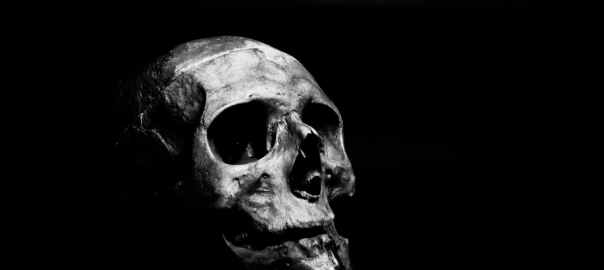
In her new book, Brandy Schillace recalls the unbelievable legacy of a Cold War era neurosurgeon’s mission to preserve the soul.

BRANDY SCHILLACE SOMETIMES writes fiction, but her new book is not that. Schillace, a medical historian, promises that her Cold War-era tale of a surgeon, neuroscientist, and father of 10 obsessed with transplanting heads is true from start to finish.

Schillace came across the story behind her book, Mr. Humble and Dr. Butcher, somewhat serendipitously: One day, her friend, Cleveland neurologist Michael DeGeorgia, called her to his office. He quietly slid a battered shoebox toward her, inviting her to open it. Schillace obliged, half-worried it might contain a brain. She pulled out a notebook—perhaps from the ‘50s or ‘60s, she says—and started to leaf through it.

“There’s all these strange little notes and stuff about mice and brains and brain slices, and these little flecks,” Schillace says. “I was like, ‘What … what are all these marks?’”

Probably blood, DeGeorgia told her. The blood-flecked notebook belonged to Robert White, a neurosurgeon who spent decades performing head transplants on monkeys, hoping to eventually use the procedure to give human brains new bodies.

Read the full story and Q&A in WIRED

Twinkling Black Holes Reveal an Invisible Cloud in Our Galaxy

WIRED

Cosmic radio backlights are helping scientists size up “missing” forms of matter and might offer clues about what makes up the universe.

AT FIRST, YUANMING Wang was not excited. More relieved, maybe. The first -year astrophysics PhD student at the University of Sydney sat in front of her computer, looking at images in which she’d found the signs of radio waves from distant galaxies twinkling, just as she had hoped. But because Wang’s discovery relied more on scouring ones and zeros than peering through a telescope—and the discovery itself was just plain weird—it took awhile for the moment to hit.

Read the full story in WIRED

How and Why to Watch NASA’s Perseverance Mars Rover Landing

WIRED

NASA’s biggest and boldest rover attempts a momentous landing on February 18

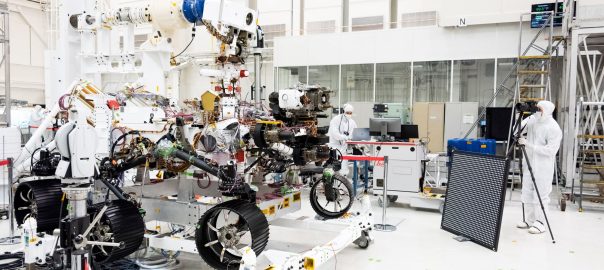
On Thursday afternoon, Perseverance, NASA’s most ambitious self-driving rover, will attempt the agency’s most challenging Mars landing. Perseverance is carrying a suite of science experiments that will search for signs of life, launch a drone helicopter, and record the planet’s audio for the first time. But conducting those experiments relies solely on whether “Percy” can stick the landing.

Read the full story in WIRED

The Coach Who Led the U.S. Math Team Back to the Top

QUANTA MAGAZINE

Po-Shen Loh has harnessed his competitive impulses and iconoclastic tendencies to reinvigorate the U.S. Math Olympiad program.

Po-Shen Loh has resurrected the United States International Mathematical Olympiad team, leading it to four first-place rankings in the last six years as the team’s head coach.

But in 2002, when a friend suggested Loh apply for an open position as a grader with the team, he hesitated. “I had never thought to apply before,” Loh said. “Not because I didn’t want to. But because I thought there are better people out there.”

He eventually agreed, and by the end of the team’s June 2002 training program, he’d made an impression. “Somehow I got voted best lecturer,” he said. In 2013 the Mathematical Association of America, which coordinates the team, asked Loh to become the head coach. He accepted, and two years later the U.S. achieved a top ranking in the IMO for the first time in 21 years.

Read the full story in Quanta Magazine

Researchers Levitated a Small Tray Using Nothing but Light

WIRED

One day a “magic carpet” based on this light-induced flow technology could carry climate sensors high in the atmosphere—wind permitting.

IN THE BASEMENT of a University of Pennsylvania engineering building, Mohsen Azadi and his labmates huddled around a set of blinding LEDs set beneath an acrylic vacuum chamber. They stared at the lights, their cameras, and what they hoped would soon be some action from the two tiny plastic plates sitting inside the enclosure. “We didn’t know what we were expecting to see,” says Azadi, a mechanical engineering PhD candidate. “But we hoped to see something.”

Let’s put it this way: They wanted to see if those plates would levitate, lofted solely by the power of light.

Read the full story in WIRED

Chemist by Training, Explorer by Heart | Q&A with NASA Materials Chemist

ACS CHEMMATTERS MAGAZINE

Yajaira Sierra-Sastre is always looking for new worlds to explore. As a young girl growing up in Puerto Rico, she gazed at stars through a clear night sky. “My first passion was for anything related to astronomy and planets and stars and space,” she says. Sierra-Sastre fell in love with science during childhood, and went on to study chemistry at the University of Puerto Rico, Mayagüez.“I could see chemistry all around me,” Sierra-Sastre says. After graduating, she started on a path to connect her studies with the real world in as many new ways as possible. “I had this desire of just going out on an adventure.”

In the 20 years since, she has used her degree to teach high school chemistry; earn a PhD making nanomaterials for space experiments; help create new types of textiles and batteries; spend months living in a Mars simulation; and oversee the research projects that keep printed money secure.

Read the full story and Q&A in ACS ChemMatters Magazine (Printed in February 2021 Issue)

Forget Blood—Your Skin Might Know If You’re Sick

WIRED

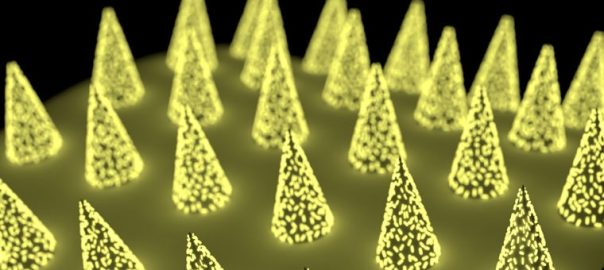
This glowing microneedle test could catalyze a transition from blood-based diagnostics to a stick-on patch.

A RIVER OF biological information flows just beneath the outermost layers of your skin, in which a hodgepodge of proteins squeeze past each other through the interstitial fluid surrounding your cells. This “interstitium” is an expansive and structured space, making it, to some, a newfound “organ.” But its wealth of biomarkers for conditions like tuberculosis, heart attacks, and cancer has attracted growing attention from researchers looking to upend reliance on diagnostic tools they say are inefficient, invasive, and blood-centric.

Read the full story in WIRED